Have you ever had an experience that made you question everything you thought you knew? Maybe you’ve been in an “altered state” due to “consuming” “substances” and had the thought: where did the ABC’s come from? like, have we always had them? Or maybe you’ve been to a particularly cool party or cultural event and seen some belly dancing – and wondered where that core-centric dance came from. Sometimes you just get really really into it and ask: what even is ART? For answers to these mind-bending questions (and more!), join us at Rickshaw Stop on June 24th at 7pm and be prepared to QUESTION EVERYTHING.*
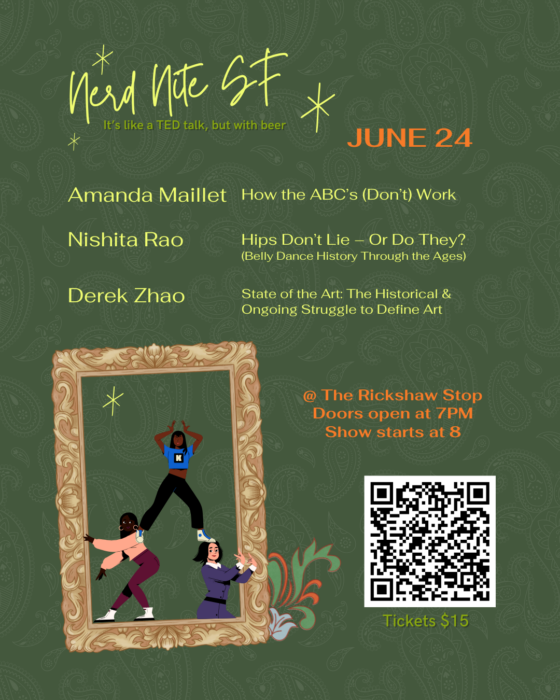
How the ABC’s (Don’t) Work
By: Amanda Maillet
I’m sure folks have heard we’re in the midst of a literacy crisis, but do they know what actually goes into learning to read? How about how the ABCs work, or rather don’t, and why we should all be way more pissed off about it? How about how the Vikings and Klingon connect to all this?
Amanda has a BA in Linguistics from the University of New Hampshire and an MS in Speech, Language, and Hearing Sciences from San Francisco State University. She currently works as Speech Therapist and especially loves early intervention (birth-age 3). Parents come to her absolutely terrified that their toddler isn’t talking yet and then come in a few months later absolutely exhausted because now they have learned how to argue. Thankfully, before becoming a speech therapist, she spent many years working as a nanny and learned, the hard way, what actually works and what absolutely does not when trying to reason with someone still very much acclimating to their own existence.
Hips don’t lie—or do they? Belly Dance History through the Ages
By: Nishita Rao
What if I told you that the term ‘Belly Dance” does not exist in any African language or in Arabic? So what is belly dance then? What role did the French, the Austrians, the English and even the Russians play in charting this oriental fantasy? Join me as I revisit the dances of Egypt! This session will highlight the 30+ Egyptian dances that existed prior to colonization: Hagala, Alexandrian, Melaya Leff, Henna, Semsemiya, Bambotiya, Dahia, Mashreqiya, Debka, Fallahi, Ghawazee, Gypsy, Baladi, Jawary, Awalem, Oriental, Saidi, Tahtieb game, Bedouin, Kaffafa, Zagala, Burmia Baharia, and more.
Nishita Rao is a Transdisciplinary Sex Researcher and Educator. Her current research delves into sex worker art forms in India and Egypt. Her broader research investigates how culture and politics influence the evolution of human social and sexual attitudes, perceptions, behaviors and artistic expressions in post-colonial societies. She hails from an academic background in Neuroscience (M.S) and Biotechnology (B.E). Nishita is also the First Indian to become an AASECT Certified Sex Educator (CSE).
State of the Art: The Historical & Ongoing Struggle to Define Art
By: Derek Zhao
What is art? For something so pervasive in our lives, art is notoriously difficult to define. Just consider the cliches and the problems they introduce. “Art makes you feel something.” So does a sunset. “Art is something made with skill and intention.” So is a highway. “Art is how we communicate feelings words can’t.” So is a panic attack. If we move beyond the slogans, rigorous philosophical definitions face similar challenges. Plato tried to make one. Tolstoy tried. Arthur Danto tried. And yet, appreciators, artists, curators, and philosophers are still left unsatisfied. I will walk you through this fascinating history of attempts to define art, show you what the current philosophical [ahem] state of the art currently is, and propose my own humble framework.
Derek Zhao is random. He is currently a machine learning engineer at Disney after retiring from a past life composing music for film and television. He has since worked in data and ML roles at NASA, Electronic Arts, and Discord. In his spare time, he pretends to be a photographer on Instagram, which leads him to constantly ask… “But is it art?”
Featuring Friends of the Show:
*Well, question most things. Be judicious about it. Sometimes reality really is just that weird.