Congratulations! You have happened upon our website, where you’ll find information on all our future and past events (going back to 2010!). We are Nerd Nite SF, a monthly lecture-in-a-bar series where people from all walks of life give presentations on everything from video game design to historic shipwrecks. We’ve hosted mimes, musicians and everyone in between, with the goal of being entertaining, silly, and most of all, educational. Come learn a new fact, make a new friend, or try a new drink! Rickshaw Stop creates a special drink based on the month’s presentations!
Welcome to Nerd Nite SF, 3rd Wednesdays at Rickshaw Stop!
Nerd Nite SF #165: Crypts Full of Skeletons, Freediving, and Fake Detectives
Ah, Fall. The time of year when trees shed their greenery and leave only their skeletons behind, so too does your friendly neighborhood Nerd Nite embrace our spooky side, and what’s more frightening than the end of the Nerd Nite SF 2026 Season? (Jump Scare!) We’re bringing out our best and spine-tingly-est talks to celebrate and you’re invited! Thrill at the crypts of Washington D.C.! Chill in the watery depths of a freedive! Marvel at the unmasking of scientific fraud! It’s all going down October 21st at Rickshaw Stop. (<- Ticket link!) Doors are at 7pm, but the terrors will last a lifetime! Calm your nerves with some Nerd Nite merch (t-shirts, posters, and books!) and take home a few treats if you dare….
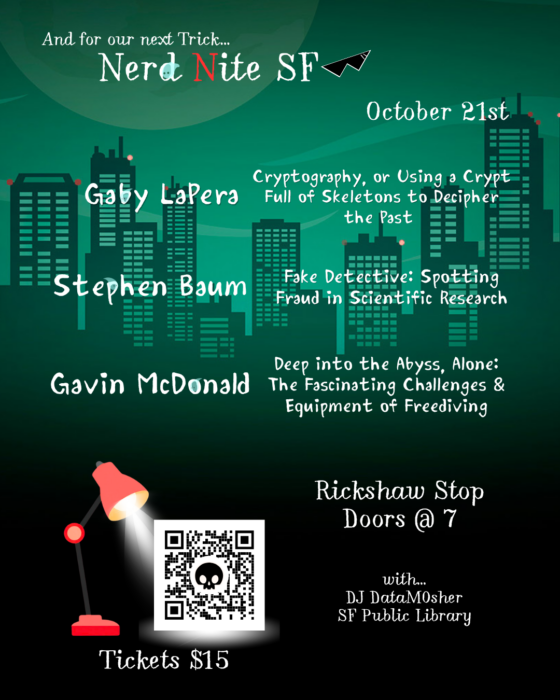
Cryptography, or Using a Crypt Full of Skeletons to Decipher the Past
By: Gaby Lapera
What can bones tell us about the lives of the people they belong to? What about the stuff they left behind? In 2009, excavations began on Causten Vault in Washington, D.C.’s Congressional Cemetery. A group of biological anthropologists, archaeologists, and historians worked together to learn the stories of the individuals buried there. We’ll talk about what they found and what it means.
Gaby Lapera is a writer in fintech with an MA in biological anthropology from the University of Nebraska-Lincoln. She runs the AnthroBiology Podcast.
Fake Detective: Spotting Fraud in Scientific Research
By: Stephen Baum
In the summer of 2022, I read an academic paper on how political orientation influences consumer preferences. Then, two things happened. First, I believed essentially nothing that the paper reported. Second, I decided to take a closer look at the data underlying the paper. I’ll describe the results of a year-long investigation into the paper, the origin of the paper’s data, and the claims that the paper makes. This is a detective story with heavy doses of subterfuge, math that does not math, automobile transmission facts, and utter buffoonery.
Stephen is a quantitative social scientist who received his PhD from UC Berkeley in 2023. He is interested in understanding how people make decisions, think about their preferences, and spend money. He likes to play ping pong, whittle, and read fiction.
Deep into the Abyss, Alone: The Fascinating Challenges and Equipment of Freediving
By: Gavin McDonald
The depths call from deep below. Dare yourself to swim as far down as you can, come back, and not die. Freediving is a minimalist sport that relies on the advanced capabilities of only two things to keep you alive: your body, and your fins. While techniques to hone the body have advanced, so has the technology and engineering put into human-powered, underwater propulsion. Both increase how deep a diver can go and how quickly they can get back to the surface.
Gavin McDonald is a certified Advanced Freediver diving to depths over 100 feet, which is not very significant in the world of freediving. All humans can freedive with the biological tools they are born with, so there is nothing special about Gavin. His other interests span sailing, advanced materials, and building things. During the day, he is an Analytics Project Manager in Healthcare.
Featuring Friends of the Show:
The SF Public Library
The SF Wikipedians
DJ DataM0sher
Nerd Nite SF #164: Freaky Animal Reproduction, How Air Pollution Makes Us Sick, and Being Funny in a 2nd Language
The cool autumn air draws near and the leaves begin to change – alas, summer is winding down. But as the Spooky Season draws near, we’ve got one last blast of hot summer content for you: sweet sizzling nerdery! Three bold speakers will be at Rickshaw Stop on September 23rd, starting at 7PM to share stories about strange animal sex strategies, how air pollution makes us sick, and how you can be funny in a non-native language. Join us!
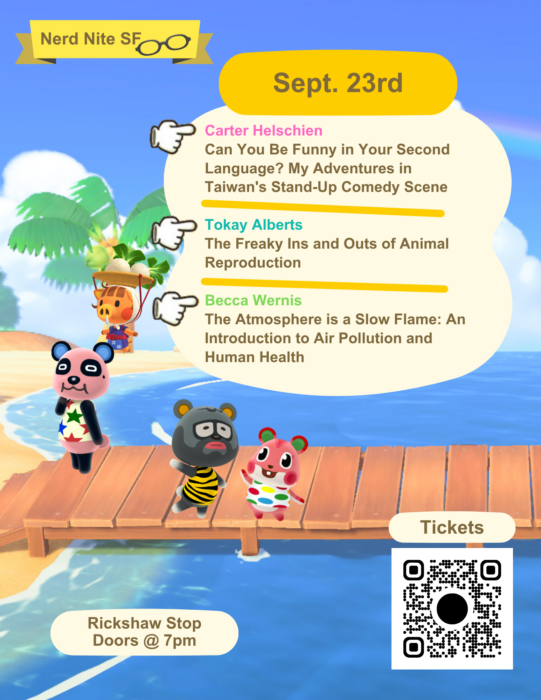
Can You Be Funny in Your Second Language? My Adventures in Taiwan’s Stand-Up Comedy Scene
Carter Helschien
After graduating from Yale, Carter (a white American whose only connection to Chinese culture was getting takeout on Christmas) moved to Taiwan to become a Mandarin-speaking stand-up comedian. He arrived just as Taiwan’s Mandarin comedy scene was beginning to break into the mainstream, forcing him to learn not only a new language on the fly, but also the invisible rules of making another culture laugh. Through jokes that landed, jokes that died, and near-daily public embarrassment, Carter explores how grammar, culture, and comedy change across languages—and how he eventually found success in places he never expected.
Professionally, Carter Helschien spends his day deciphering Gen Alpha slang so he can ban it (at Roblox). He comes from a family of professional gymnasts, but at 6’3″, was genetically disqualified from joining the family business. Instead, he spends his time cooking, crocheting, building community, and mentoring low-income high school students through Minds Matter. He recently moved to San Francisco and is now looking for his soulmate; or, at minimum, “someone I can put on my shoulders in a trench coat so we form a mega-person.”
The Freaky Ins and Outs of Animal Reproduction
Tokay Alberts
Beyond the birds and bees, animals of all kinds have been getting freaky around the world. Time to learn the ins and outs (and back in and back out) of how animals get it on.
Tokay Alberts is a Masters student in the SFSU Boria lab studying urban ecology and genomics of small mammals in the Bay Area. He is also an animal reproduction enthusiast.
The Atmosphere is a Slow Flame: An Introduction to Air Pollution and Human Health
Becca Wernis
Sure, there’s a lot of nitrogen and oxygen in the atmosphere, but the trace gases (present at parts per million, billion, or even trillion) are where the action is really at. We’ll explore the complex interactions between volatile organic compounds (VOCs) and free radicals, the impacts of air pollution on human health, and the techniques we use to quantify and understand which chemicals are airborne and how they got there.
Dr. Becca Wernis is a systems engineer developing advanced VOC measurement equipment at Picarro. Before that she developed (different) advanced VOC measurement equipment during her Environmental Engineering PhD at UC Berkeley. When not worrying about measurement precision and firmware bugs, she loves to ride public transit, fix strangers’ bikes, and advocate for safer streets.
Featuring Friends of the Show:
The SF Public Library
The SF Wikipedians
Nerd Nite SF #163: Caving 101, Gin & Tonics & Terawatt Wire Explosions
Hey. What are YOU up to this summer? Taken any trips lately? You’ve come to the right place for some travel advice. If you’re feeling the heat, why not enjoy the cool cozy confines of a cave? If you’re ready to see the world, why not follow in the surprisingly medicinal steps of one of the all time drinks, the Gin and Tonic? If all this travel has you feeling revved up, what better way to party down than by blowing up some wires with absurd amounts of electricity? Alternatively, you can save yourself the hassle and join us at Rickshaw Stop at 7pm on August 18th and let our speakers show you the woooooooorld!
Caving 101: An Insider’s Guide to Exploring the Underground
Vivek Zilpelwar
While most of the Earth’s surface has been mapped and explored, a vast frontier still exists completely out of sight right beneath us. This talk provides an exclusive insider’s look into caving – a niche technical sport which requires constant problem-solving, physical/mental endurance, and serious teamwork. Discover what it truly feels like to step into the unknown, navigate challenging environments, and stand in places where very few people have been before.
Vivek Zilpelwar is a hardware reliability engineer in San Francisco with a background in transportation-based product development. For the last eight years, he has been a technical caver, exploring primarily in the Southwest US as well as internationally. When above ground, he enjoys self-improvement, all things adventure related, and meeting interesting new people.
Around the World with the Gin & Tonic
By: Camper English
The history of the G&T includes the history of malaria (prevented and cured by quinine in tonic), the Black Death (repelled by juniper), Jesuit missionaries in Peru, the swamps of Rome, the Belgian Congo, horse races in India, Greek medicinal wines, the World Health Organization, the Dutch in Indonesia, Australians in Bolivia, French scientists in the lab, and if there’s time we’ll include cats dropped out of airplanes, the invention of the color mauve, Little House on the Prairie, the birth of chemotherapy, the Official Preppy Handbook, and how the wrong ice machine inspired the creation of the Spanish-style Gin and Tonic.
Camper English is a cocktails and spirits journalist who has been covering drinks in SF for decades. He is the author of Doctors and Distillers: The Remarkable Medicinal History of Beer, Wine, Spirits, and Cocktails, and also a book about ice cubes. Check out his writing, classes, and bar history tours on Alcademics.com.
EX-pinch: Surprising Physics from Terawatt Wire Explosions
Glenn Carroll
The field of exploding wires is littered with discredited theories, not-quite-accurate models, and fraught speculations. The X-pinch variant of exploding wires is quite simple: two (or more) wires are twisted together to form an X and then electrically detonated. Unexpectedly, X-pinch has novel, spectacular, and highly useful behavior, proving that explosions can be not only fun, but also practical and handy tools for science!
Glenn Carroll is the son of an experimental high-energy physicist, and has always believed that physics is too much fun to leave it to government-funded bureaucracy. Besides reading the history and academic papers on ex-wires, he has “experimented” with detonating a half-dozen different metals, at lengths up to 10 meters, in several shapes, as well as firing multi-wire arrays, underwater detonations, foil squares, a disco ball, and so on.
With Friends of the Show:
Nerd Nite SF #162: “Curing” Hysteria, The Sharks of San Francisco Bay, and Who Speaks for Earth?
Is it really that time again? Another Nerd Nite so soon? Yes, dear nerds, I’m pleased to say it’s true: Nerd Nite SF returns to Rickshaw Stop on July 15th at 7pm! Have you ever wondered who on Earth is (officially) trying to talk to aliens? Have you ever wondered what “hysteria” actually was as a “medical condition” or how it was “cured?” Did you know that there’s some really heckin’ old sharks living in the Bay and if you want you can join a research team to study them? (it’s true! you literally just sign up!) We’ve all got a lot of questions these days; the world is a confusing place. Luckily, we’ve got some answers. Come on down!
Messaging ET: Who Speaks for Earth?
By: Julia DeMarines
Did you know that humans have sent over a dozen high powered messages to space to intentionally get a response from potential ET onlookers? While most people aren’t aware of these activities, these messages speak on behalf of humanity and all beings on our planet who have no say in the matter! This raises ethical questions: Should we be messaging at all? What should these messages say? And most importantly, who speaks for Earth? In this talk I will discuss the Dear ET project – an international effort that bridges active philosophy and STEAM education to raise awareness of these messaging efforts, support legitimate global representation, and hopefully enact messaging policy in the future.
Julia DeMarines is an Astrobiologist working as a senior scientist on evolutionary intelligence for a data architecture company treating AI like an ET. She is a National Geographic Explorer and Educator, a (sorta) grad student in UC Berkeley’s Earth & Planetary Science, and a researcher with the Blue Marble Space Institute of Science. She was recently appointed as an early-career liaison for the SETI Institute’s new Discoveries and Futures lab and serves on the advisory board for NSF’s NCAR Education, Engagement & Early-Career Development program. Her research involves detecting life in space through biosignatures and technosignatures and the ethics of sending messages to contact aliens. Julia’s work in astrobiology is driven by her curiosity and passion for exploring the unknown, and she is committed to advancing our understanding of the universe and our place within it. When she’s not engaged in science and communication, she can be found avoiding UFO conversations, cracking Uranus jokes, mountain biking, lifting with the bros, and rock climbing.
“Curing” Hysteria: Strange Remedies and Women’s Resistance in the 19th-Century U.S.
By: Vivian Wolf
In the nineteenth-century United States, women diagnosed with hysteria and other nervous disorders were prescribed treatments including prolonged bed rest, all-milk diets, hydrotherapy, and electrical stimulation. This talk examines the cultural and economic forces behind these so-called cures while exploring how writers challenged prevailing ideas about health.
Vivian Delchamps Wolf (PhD, UCLA English, 2022) is an Assistant Professor of English at Dominican University of California. Her research and teaching focus upon 19th-century American literature and feminist disability studies. Her book in progress, Resisting Diagnosis: Women’s Disability Literature of the 19th-Century U.S., analyzes the ways women writers use literature to challenge harmful issues within medical systems and beyond.
Sharks of San Francisco Bay: What We Know, What We are Learning, and How You can Take Part
By: Meghan Holst
San Francisco Bay is home to a diverse and historically significant population of sharks, but much remains unknown about their long-term conservation needs. In this talk, Dr. Meghan Holst of Ocean Science Expedition Academy (OSEA) will share what we currently know about Bay sharks, the critical research questions OSEA is working to answer, and how the organization is creating equitable, hands-on opportunities for community members to take part in real marine science. Whether you’re a curious local or an aspiring researcher, you’ll leave with a new appreciation for the sharks in your backyard and how you can help protect them.
Dr. Meghan Holst is a marine scientist and University of California, Davis researcher studying sharks, rays, and skates in San Francisco Bay. She is working to characterize the Bay as a critical reproductive area for elasmobranchs while identifying threats to these populations from contaminants and environmental stressors. Driven by a commitment to inclusive science, she co-founded Ocean Science Expedition Academy (OSEA), a nonprofit sustaining long-term shark research in San Francisco Bay while creating pathways for community members to develop field skills and engage in local marine science. Her work is defined not only by the science she produces, but by the community she is building around it; one that reflects the full diversity of people who care about our oceans.
Featuring Friends of the Show:
The SF Public Library
DJ & Jelly
Nerd Nite SF #161: Rethinking the ABCs, Belly Dancing, and the Definition of Art
Have you ever had an experience that made you question everything you thought you knew? Maybe you’ve been in an “altered state” due to “consuming” “substances” and had the thought: where did the ABC’s come from? like, have we always had them? Or maybe you’ve been to a particularly cool party or cultural event and seen some belly dancing – and wondered where that core-centric dance came from. Sometimes you just get really really into it and ask: what even is ART? For answers to these mind-bending questions (and more!), join us at Rickshaw Stop on June 24th at 7pm and be prepared to QUESTION EVERYTHING.*
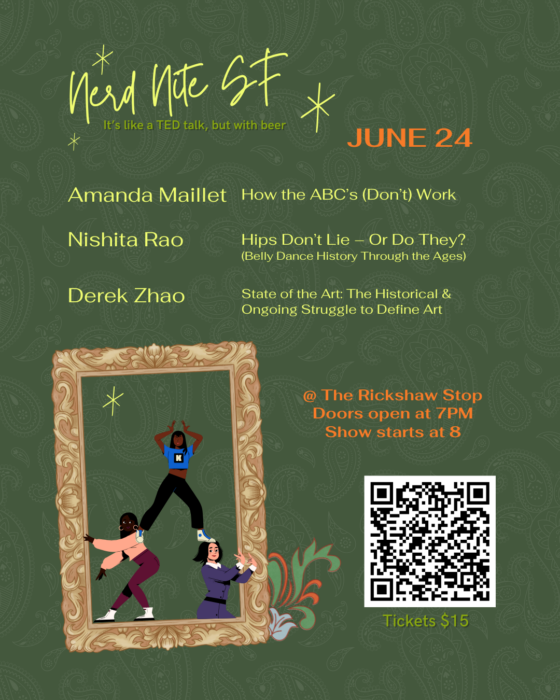
How the ABC’s (Don’t) Work
By: Amanda Maillet
I’m sure folks have heard we’re in the midst of a literacy crisis, but do they know what actually goes into learning to read? How about how the ABCs work, or rather don’t, and why we should all be way more pissed off about it? How about how the Vikings and Klingon connect to all this?
Amanda has a BA in Linguistics from the University of New Hampshire and an MS in Speech, Language, and Hearing Sciences from San Francisco State University. She currently works as Speech Therapist and especially loves early intervention (birth-age 3). Parents come to her absolutely terrified that their toddler isn’t talking yet and then come in a few months later absolutely exhausted because now they have learned how to argue. Thankfully, before becoming a speech therapist, she spent many years working as a nanny and learned, the hard way, what actually works and what absolutely does not when trying to reason with someone still very much acclimating to their own existence.
Hips don’t lie—or do they? Belly Dance History through the Ages
By: Nishita Rao
What if I told you that the term ‘Belly Dance” does not exist in any African language or in Arabic? So what is belly dance then? What role did the French, the Austrians, the English and even the Russians play in charting this oriental fantasy? Join me as I revisit the dances of Egypt! This session will highlight the 30+ Egyptian dances that existed prior to colonization: Hagala, Alexandrian, Melaya Leff, Henna, Semsemiya, Bambotiya, Dahia, Mashreqiya, Debka, Fallahi, Ghawazee, Gypsy, Baladi, Jawary, Awalem, Oriental, Saidi, Tahtieb game, Bedouin, Kaffafa, Zagala, Burmia Baharia, and more.
Nishita Rao is a Transdisciplinary Sex Researcher and Educator. Her current research delves into sex worker art forms in India and Egypt. Her broader research investigates how culture and politics influence the evolution of human social and sexual attitudes, perceptions, behaviors and artistic expressions in post-colonial societies. She hails from an academic background in Neuroscience (M.S) and Biotechnology (B.E). Nishita is also the First Indian to become an AASECT Certified Sex Educator (CSE).
State of the Art: The Historical & Ongoing Struggle to Define Art
By: Derek Zhao
What is art? For something so pervasive in our lives, art is notoriously difficult to define. Just consider the cliches and the problems they introduce. “Art makes you feel something.” So does a sunset. “Art is something made with skill and intention.” So is a highway. “Art is how we communicate feelings words can’t.” So is a panic attack. If we move beyond the slogans, rigorous philosophical definitions face similar challenges. Plato tried to make one. Tolstoy tried. Arthur Danto tried. And yet, appreciators, artists, curators, and philosophers are still left unsatisfied. I will walk you through this fascinating history of attempts to define art, show you what the current philosophical [ahem] state of the art currently is, and propose my own humble framework.
Derek Zhao is random. He is currently a machine learning engineer at Disney after retiring from a past life composing music for film and television. He has since worked in data and ML roles at NASA, Electronic Arts, and Discord. In his spare time, he pretends to be a photographer on Instagram, which leads him to constantly ask… “But is it art?”
Featuring Friends of the Show:
*Well, question most things. Be judicious about it. Sometimes reality really is just that weird.
Nerd Nite SF #160: Japanese Cocktail Histories, How to Throw a FUNCTION, and This is NOT Legal Advice
We like to have a good time here at Nerd Nite. In fact, we think of our show as a kind of educational party, a one-bar crawl through the beautiful strangeness of the world and all the fascinating things in it, brought to you every month with a healthy dose of liquid courage. That’s why this month we’re featuring three spectacular speakers who will get your party going! Every party needs good drinks and every party-er needs good anecdotes to keep the conversation rolling, so where better to start than a cocktail that tells the history of Japan’s modern drinking culture? Once you’ve picked your drinks of choice it’s time to call in a professional party planner – get ready to learn the art and science of throwing a FUNCTION. Of course, most parties get a little bit out of control at some point (at least, the good ones do), and when that happens you need to know just how close you can get to the letter of the law without going over. (We have to assume that party cops follow The Price is Right rules.) So come on down to the Rickshaw Stop on May 27th at 7pm for all you need to know to get this party started!
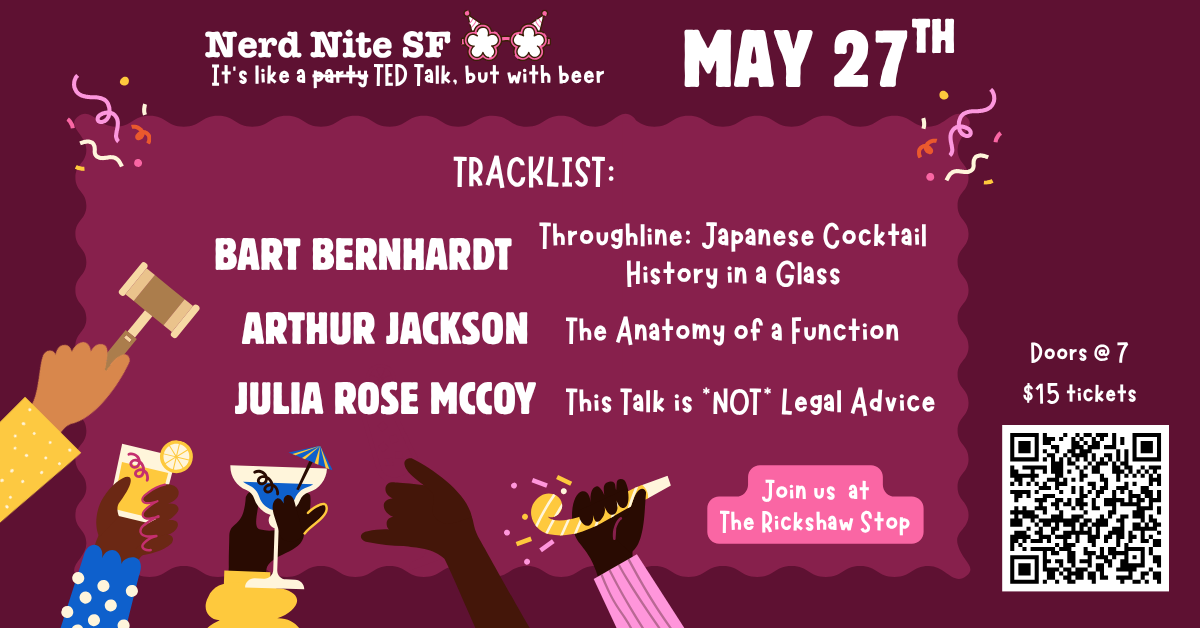
Throughline: Japanese Cocktail History in a Glass
Bart Bernhardt
When Commodore Perry forced Japan at gunpoint to end its policy of isolationism, it ushered in an era of change that reverberates to this day. With Western visitors came Western vices, such as the cocktail. We’ll learn how this American culinary invention became a fixture of modern Japan by looking at a single drink – The Line, invented by Yonekichi Maeda in 1924 – and how gunboat diplomacy, wars, jazz, earthquakes, and especially women – created Japanese cocktail culture. And how, 100 years later, that culture now influences American bartending.
Bart is a bartender at The Interval at Long Now. The Long Now Foundation is a nonprofit dedicated to cultivating long-term thinking, and regularly hosts fascinating lectures, creates art, and many other projects. The Interval is the bar/cafe and social space for the Long Now, and has been named “Best Cocktail Bar” in San Francisco Magazine.
The Anatomy of a Function
Arthur Jackson
Nobody knows how to have fun any more, what ever happened to fun? New York [San Francisco] is over! O-V-E-R! OVER. I’m so bored I could die. No one is dancing anymore when they should be breaking their spines on the dancefloor! When was the last time you held your friend’s hair back while she vomited in the boys urinal? Have you ever shot a beer pong ball from your mouth and won the game? When’s the last time you stunted on these hoes?
Arthur Jackson V is a gay Bay Area artist of many disciplines- bartender, painter, DJ, Poet, and actor. His goal is to find a way to marry all of these parts of himself together, and keep alive the saying « Shake a tail feather ». At the heart of it he’s a storyteller, waiting for you near a fire, with a bottle of wine, a pack of stogues, and music to spin.
This Talk is *NOT* Legal Advice
Julia Rose McCoy
Ever wondered what legal rules attorneys might follow of their own free will, sort of just for kicks? Well now you can watch a real life attorney muse out loud to herself about arbitration agreements, interacting with the police, and what she wishes people knew about securing legal assistance using the thinly veiled metaphor of Dungeons and Dragons! Hey, what’s this room full of people doing here? Hope they don’t hear her musings, because then they might think it was legal advice, which it isn’t. After all, she is an attorney, she’s just not your attorney.
Julia Rose McCoy is a plaintiff’s side employment attorney, a total legal dork, and a middling public speaker. In her spare time, she plays dungeons and dragons, tries to leash train her cat, and rants to her partner about the news. She is a staunch anticapitalist and lifelong fan of both jazz and the San Francisco Public Library. Please come speak to her after the talks about whatever nerdy thing is running your life right now.
Featuring Friends of the Show: